

Marketing workflows are under more pressure than ever. Teams are expected to launch campaigns faster, support more channels, personalize content for different audiences, respond to performance insights quickly, and still maintain strong brand consistency across every digital touchpoint. What makes this difficult is that many marketing operations are still built on systems designed for a simpler digital environment. Content may be locked into rigid page templates, scattered across several tools, or tied too closely to workflows that are slow to adapt when business needs change. As a result, marketers often spend too much time managing content production and not enough time improving the actual customer experience.
- Why Traditional Marketing Workflows Are Reaching Their Limits
- What Future-Ready Marketing Workflows Actually Mean
- How Headless CMS Changes the Foundation of Content Operations
- Building Workflows Around Structured Content Instead of Isolated Pages
- Making Multi-Channel Execution More Practical and More Consistent
- Supporting Faster Campaign Launches Without Sacrificing Control
- Enabling Smarter Collaboration Between Marketing and Development
- Making Personalization Easier to Scale Over Time
- Improving Content Governance as Complexity Increases
This is why future-ready workflows matter so much. A future-ready marketing workflow is not just faster. It is more adaptable, more scalable, and better able to support the growing complexity of digital communication. Headless CMS plays an important role in building that kind of workflow because it separates content from presentation and gives organizations a more flexible content foundation. Instead of treating every page, campaign, or channel as a separate publishing problem, teams can structure content in ways that support reuse, coordination, and continuous improvement. That shift helps marketing become more resilient and more capable of keeping pace with what modern digital growth actually requires.
Why Traditional Marketing Workflows Are Reaching Their Limits
Many traditional marketing workflows were built around a website-first mindset. Content was created for specific pages, approved through linear processes, and published in systems where layout, presentation, and editing were closely connected. Check it out to see how more flexible content workflows can help marketing teams keep content connected across channels, formats, and customer journeys. That model worked reasonably well when brands had fewer digital channels and lower expectations around personalization, campaign velocity, and content reuse. Today, however, marketers operate across landing pages, apps, email journeys, paid campaigns, portals, resource centers, and more. Customers also move between these environments quickly, which means content needs to stay connected even when it appears in very different formats.
This is where older workflows begin to show their limits. Teams often have to duplicate similar content across systems, depend too heavily on manual editing, and wait too long for changes that should be simple. The result is a workflow that becomes heavier as marketing grows. Instead of scaling efficiently, it produces more friction, more inconsistency, and more delays. A future-ready workflow has to solve that problem at the structural level. It has to make it easier for teams to produce, adapt, and distribute content without increasing complexity every time the business adds a new campaign, new channel, or new audience requirement.
What Future-Ready Marketing Workflows Actually Mean
A future-ready marketing workflow is not just a faster version of the current process. It is a workflow designed for flexibility, reuse, multi-channel coordination, and ongoing optimization. It allows teams to respond to changing business priorities without constantly rebuilding content operations from scratch. It supports both short-term campaign execution and long-term strategic consistency. Most importantly, it recognizes that content is no longer tied to one destination. Instead, content must move fluidly across digital touchpoints and adapt to different contexts without losing clarity or control.
In practice, this means future-ready workflows are built around structured content, shared systems, and stronger operational visibility. Teams can create once and reuse intelligently. They can launch quickly without losing governance. They can personalize without fragmenting the brand. They can update core messages centrally and distribute them across the channels that matter. A workflow becomes future-ready when it can absorb growth rather than being overwhelmed by it. That is why headless CMS has become such a strong fit for modern marketing organizations. It helps create the kind of content environment where flexible workflows are not just possible, but sustainable over time.
How Headless CMS Changes the Foundation of Content Operations
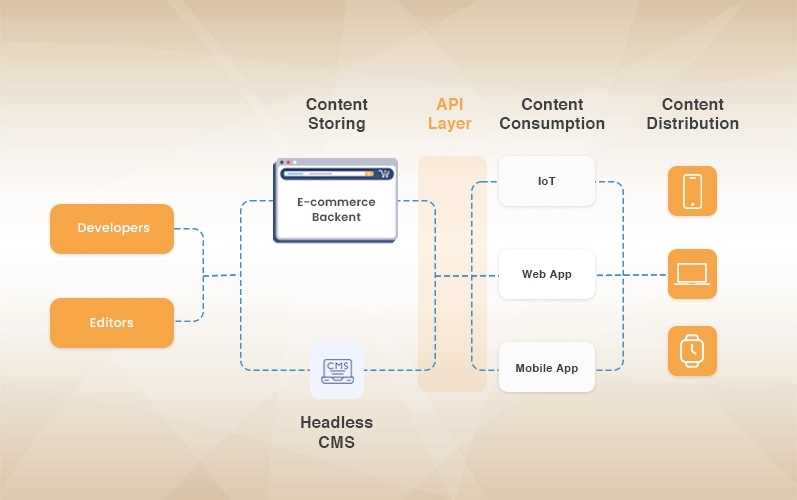
A headless CMS changes content operations by separating content management from the front-end environments where the content appears. In traditional systems, content is often created directly inside a website or specific page structure, which makes it harder to reuse and more difficult to adapt across channels. If the same message needs to appear in a mobile experience, a campaign page, an app, and a portal, teams may have to recreate or manually transfer that content multiple times. This makes workflows slower and increases the risk of inconsistency.
With a headless CMS, content is managed in a central system and then delivered through APIs to whatever digital experiences need it. This changes the workflow because the team is no longer building each output as a completely separate project. Instead, it is working from a shared content foundation. That foundation supports reuse, coordination, and faster updates. It also improves resilience, because the business can evolve its front-end experiences without having to rebuild the entire content operation every time. For future-ready marketing workflows, this separation is essential. It gives teams more flexibility in how they create and distribute content while keeping the system behind that work much more organized and scalable.
Building Workflows Around Structured Content Instead of Isolated Pages
One of the biggest differences in a headless CMS environment is the shift from page-centric thinking to structured content thinking. In many marketing teams, the workflow still begins with a specific output, such as a landing page, campaign page, or website section. The team writes content for that destination, approves it, and publishes it there, often without considering how the same content could support other experiences. This creates duplication and limits flexibility because each asset is treated as an isolated piece of work.
Structured content changes that model. Instead of creating everything as one large, fixed block, content is broken into meaningful parts such as headlines, summaries, proof sections, product highlights, value statements, and calls to action. These elements can then be reused across channels and assembled in different ways depending on the need. This improves future readiness because the workflow becomes less dependent on recreating similar materials every time a new initiative appears. Teams can move faster, reduce waste, and keep messaging more consistent because they are working with a content system designed for reuse rather than one designed around one-off page creation.
Making Multi-Channel Execution More Practical and More Consistent
Modern marketing depends on multi-channel execution, but many workflows are still not truly built for it. Teams may publish campaign content across a website, email flow, app, paid landing page, and product section, yet each channel often has its own separate content process. This makes coordination difficult and creates unnecessary repetition. A message that changes in one touchpoint may stay outdated in another. A campaign that feels aligned in one channel may sound different in another. Over time, this weakens both efficiency and customer trust.
Headless CMS helps solve this by giving teams one content source that can support several destinations. That makes multi-channel execution far more practical because core content no longer has to be rebuilt or manually copied into each new environment. It also improves consistency because the underlying message stays connected even when the presentation changes by channel. In future-ready workflows, that kind of consistency is essential. Customers do not see channels as separate internal systems. They experience them as one brand journey. A workflow that supports coordinated multi-channel delivery helps ensure that the brand feels more coherent and the team can scale communication more effectively as digital ecosystems become more complex.
Supporting Faster Campaign Launches Without Sacrificing Control
Campaign speed is one of the clearest stress points in modern marketing workflows. Teams are often expected to launch quickly, respond to trends, support multiple variants, and still keep every asset aligned with brand and business priorities. In rigid systems, this often creates a trade-off between speed and control. If teams move quickly, they risk inconsistency. If they follow slow manual processes, they miss momentum. Neither option is ideal for a marketing function that needs to be both agile and dependable.
A headless CMS creates a better balance by enabling content to be reused and assembled more efficiently from structured components. Marketers do not need to start from zero every time a campaign launches. They can build from approved content blocks and adapt the experience according to the campaign goal. This speeds up production while still keeping the campaign connected to shared brand logic. It also helps teams apply updates more quickly if a message needs to change after launch. In future-ready workflows, campaign execution should not feel like a constant emergency response. It should feel like a disciplined process that supports speed without abandoning quality. Headless CMS helps make that much more realistic.
Enabling Smarter Collaboration Between Marketing and Development
A future-ready workflow depends on good collaboration, especially between marketing and development teams. In older systems, these two groups often become trapped in unnecessary dependencies. Marketing needs content changes and flexible campaign execution, while development is asked to support repeated publishing tasks and layout adjustments that take time away from more strategic work. This creates tension because both teams are trying to do valuable work, but the system forces them into overlapping responsibilities and slow back-and-forth coordination.
Headless CMS improves this relationship by creating clearer boundaries. Marketing and content teams can manage structured content more independently, while development focuses on experience delivery, performance, integrations, and front-end quality. That does not remove collaboration. It makes collaboration more useful because it happens around strategic improvements rather than routine publishing friction. For future-ready workflows, this is a major strength. Teams need operating models where each side can move efficiently without blocking the other. When content and presentation are decoupled, marketers gain more autonomy and developers gain more room to focus on higher-value technical work. That leads to stronger execution across the board.
Making Personalization Easier to Scale Over Time
Personalization is one of the clearest signs that a workflow needs to be future-ready. The more businesses want to tailor content by audience, channel, stage, or behavior, the more pressure they place on the content system itself. In traditional workflows, personalization often becomes difficult because it requires too many duplicated assets and too much manual variation. Teams may create separate pages, separate messages, and separate versions for different scenarios until the workflow becomes too complex to manage cleanly. At that point, personalization becomes operationally expensive.
Headless CMS supports a more scalable approach because content can remain centralized while selected pieces are adapted according to context. This allows businesses to personalize more intelligently without creating a completely separate content universe for every segment or channel. In a future-ready workflow, personalization should increase relevance without weakening consistency or making maintenance unmanageable. A headless CMS makes that more achievable because the same structured content foundation can support different experiences while still remaining connected to central messaging and governance. That helps teams personalize at scale without turning the workflow into a growing collection of disconnected and increasingly difficult assets.
Improving Content Governance as Complexity Increases
As marketing operations grow, governance becomes more important, not less. More campaigns, more channels, more contributors, and more versions all increase the risk that content will drift away from approved messaging, outdated assets will remain in circulation, or different teams will create overlapping materials without coordination. In simple environments, governance can sometimes rely on memory and manual review. In more complex organizations, that approach becomes increasingly fragile. A future-ready workflow needs a stronger operational model for keeping content clear, current, and aligned.
Headless CMS supports this by centralizing content and making ownership more visible. Core messages, reusable components, and structured content types can be governed from one system instead of scattered across many disconnected tools. This makes approvals more manageable and updates easier to track. It also helps organizations reduce the risk of version confusion, because teams know where the source content lives and how it should be reused. Governance in this sense is not about slowing teams down. It is about making scale more sustainable. The more complex marketing becomes, the more important it is to have a workflow that supports control without destroying agility, and headless CMS helps deliver that balance.
Refresh Date: August 22, 2026